
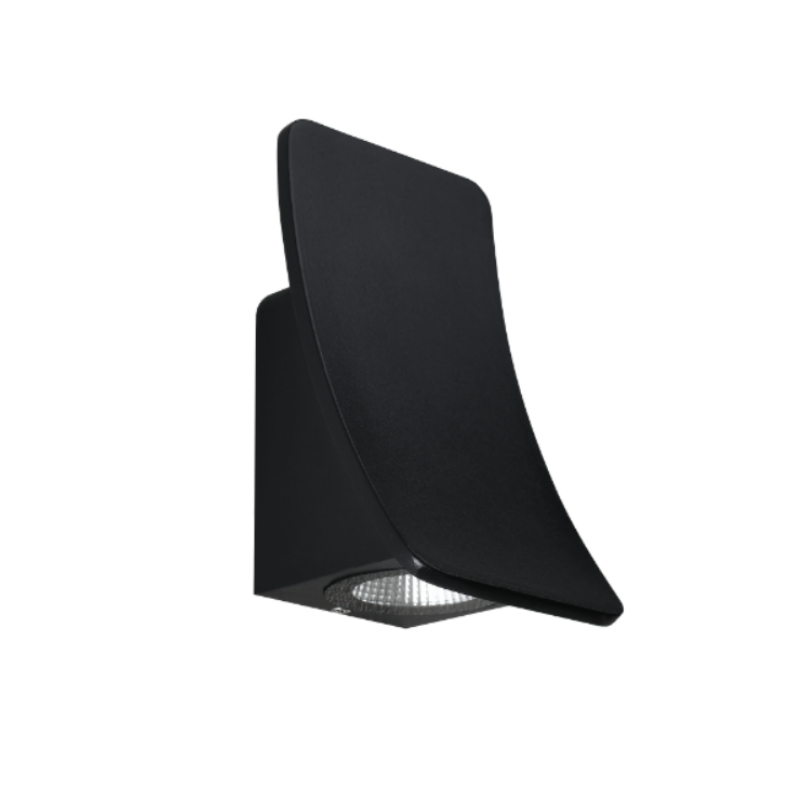
Opening the problem: why beam control matters more than you think
Commercial exterior lighting often fails not because fixtures are cheap, but because their optics are wrong. If the beam is too wide you waste lumen output on facades and sidewalks; too narrow and you get hot spots and glare that annoy occupants and trigger complaints. That’s why lens engineering — the small, precise science behind waterproof outdoor wall lights — matters. Good lens design balances beam angle, lumen output, and glare control so a property looks great and stays safe without wasting energy. Municipal guidelines and industry practice (see Illuminating Engineering Society — IES — recommendations) increasingly demand that kind of precision, so this isn’t just aesthetic nitpicking; it’s compliance and cost control too.

The physics in plain English: what lenses actually do
Lens elements refract and redirect light emitted from an LED array into a predictable beam spread. The lens profile — whether simple plano-convex, asymmetric, or a multi-element optic — sets the beam angle and intensity distribution. Material refractive index and surface finish influence efficiency and chromatic uniformity. In short: the shape and material of the lens define where the light lands. If you want even wall washing versus sharp accenting, you choose different optical geometries. That’s basic optics, but applied at scale for exterior wall lighting it becomes a commercial design decision.
Common problems brands and specifiers run into
Three issues show up again and again: mismatched beam angle versus mounting height, poor cutoff leading to neighbor glare, and over-specifying lumen output instead of refining optics. Designers sometimes compensate for a wide, inefficient lens by increasing lumen output — which raises energy use and causes uncomfortable glare. Another frequent mistake: assuming all “waterproof” fixtures deliver the same distribution. They don’t. And if you’re working on smaller projects — say a garden installation — the wrong lens can ruin planting highlights or cast unwanted shadows in patios. For residential projects, a well-specified garden wall lamp with a tailored optic often beats a generic floodlight every time.
Real-world anchors: standards, examples, and why they matter
The IES provides lighting guides that many municipalities reference; those guides emphasize distribution and glare control as much as raw lumen counts. Meanwhile, widespread LED retrofits in commercial districts have shown energy reductions commonly in the 30–70% range when optics are optimized alongside drivers and controls. In practice, a retail façade retrofit in a mid-sized city that swapped basic floods for lens-optimized wall lights improved uniformity and cut energy bills notably — and tenant complaints fell. These are the kinds of measurable wins that turn a lighting spec from theory into ROI.
How to evaluate lens engineering when you specify fixtures
Bring optics into the early design conversation. Ask for photometric files (IES or LM-63 formats), check beam angle and candela distribution, and request first-article photometry at the mounting height you plan to use. Don’t forget environmental factors: temperature and ingress protection ratings affect long-term optical performance. And test with your actual mounting conditions — light reflected off brick or glass changes apparent uniformity. Small trials prevent big headaches on a roll-out. —
Trade-offs and practical solutions
There’s always a trade-off between cost, performance, and flexibility. Multi-element optics give the most control but add cost and sometimes increase fixture depth. Simpler lenses are cheaper but less forgiving. For many commercial applications, a modular approach works best: choose a fixture platform that supports field-replaceable optics so you can tune beam spread post-installation without ripping down the whole unit. That flexibility lowers lifecycle cost and reduces warranty disputes — a pragmatic engineering compromise.
Common mistakes to avoid
• Specifying only lumens. Without distribution metrics, lumen figures are meaningless. • Ignoring mounting geometry. Beam angle must match mounting height and distance to target. • Skipping photometric verification. Don’t accept manufacturer claims without an IES plot or on-site mockup.

Advisory — three critical evaluation metrics when choosing optics
1) Distribution fidelity: Require IES files and verify uniformity (max/min ratios) at your intended mounting height. 2) Glare control and cutoff: Check UGR (Unified Glare Rating) or equivalent photometric evidence so you avoid complaints and meet local codes. 3) Maintainability and modularity: Prefer fixtures that let you swap lenses or adjust aim in the field — that saves money over the life of the project.
When those three metrics are the baseline, you choose fixtures that perform, comply, and last — and that’s ultimately what specifiers and property owners pay for. For practical, engineered outdoor optics that balance those needs, Keyida. —

